Dogma Organics
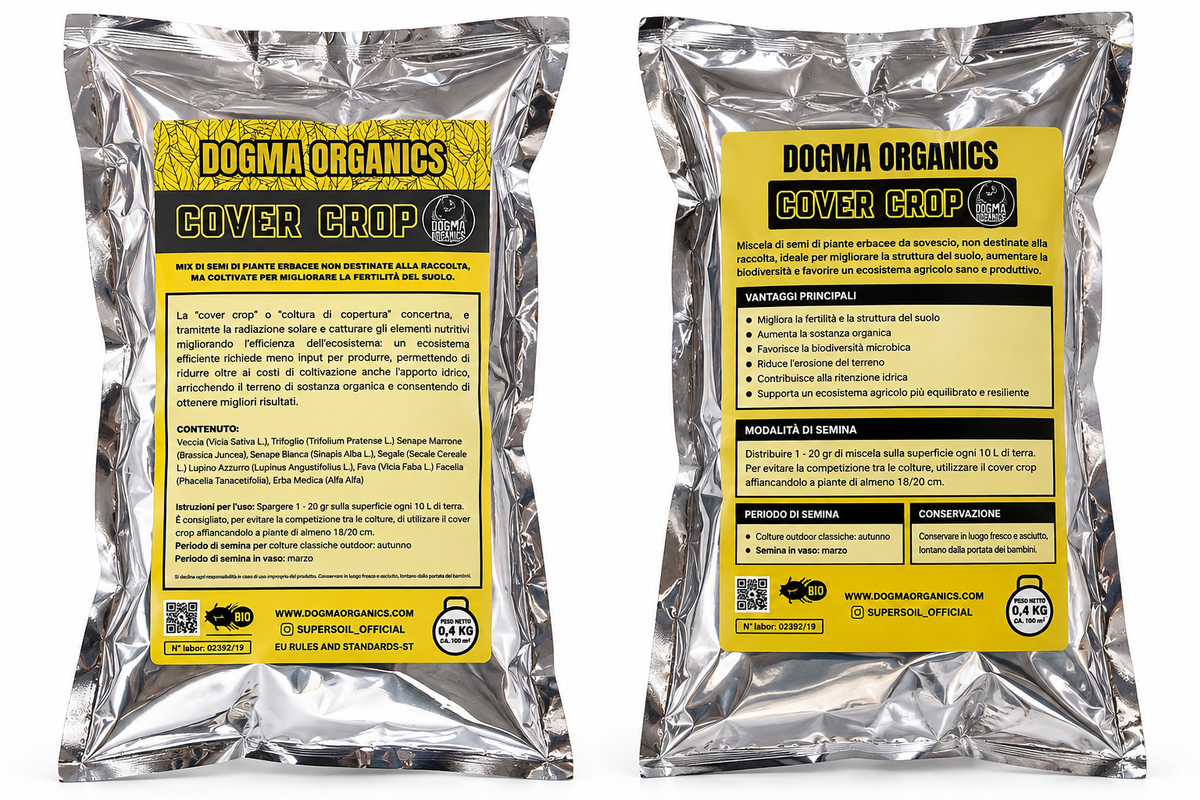
Dogma Cover Crop
Dogma Cover Crop
Couldn't load pickup availability
Cover crops, also known as intercrops, can capture solar radiation and nutrients, thereby improving the efficiency of the entire plant-soil ecosystem. An effective ecosystem requires fewer inputs for production, thus reducing water consumption and enriching the soil with organic matter.
The main advantages are as follows: • Improvement of the physical and biological quality of the soil
• reduces soil erosion
• Affects the permeability of the soil and ensures an optimal water infiltration rate
• increases the organic matter in the soil
• increases the availability of nitrogen and other nutrients
• BRASSICA JUNCEA (Brown Mustard)
Due to its high content of bioactive substances, it is very resistant to pathogenic fungi and soil parasites.
• VICIA SATIVA (Fox Vetch)
It produces a lot of biomass and thus releases large amounts of nitrogen, which helps to control weeds.
• SECALE CEREALE L. (rye)
It makes an important contribution to reducing nitrogen leaching and also suppresses weeds.
• ALFA ALFA (Alfalfa)
It binds atmospheric nitrogen by storing it.
• LUPINUS ANGUSTIFOLIUS L. (Narrow-leaved lupine)
The symbiotic bacteria living in its roots absorb atmospheric nitrogen and make it available to the soil.
• PHACELIA TANACITOFILA (Phacelia)
Besides releasing large amounts of nitrogen into the soil, it produces chemical substances that play an important role in suppressing weeds.
• SINAPSIS ALBA L. (White Mustard)
It guarantees excellent biomass production.
• VICIA FABA L. (broad bean)
The nutrient and structural properties of the soil are improved by the abundant biomass and the ability to bind nitrogen.
• TRIFOLIUIM PRATENSE (meadow clover)
The yield is improved because it also has the ability to bind nitrogen, enriching the soil with it.
Sow when the plant has reached a height of 15/20 cm.
The 0.8 kg package allows for sowing of the corresponding volume of 400/450 liters of Supersoil.
shares